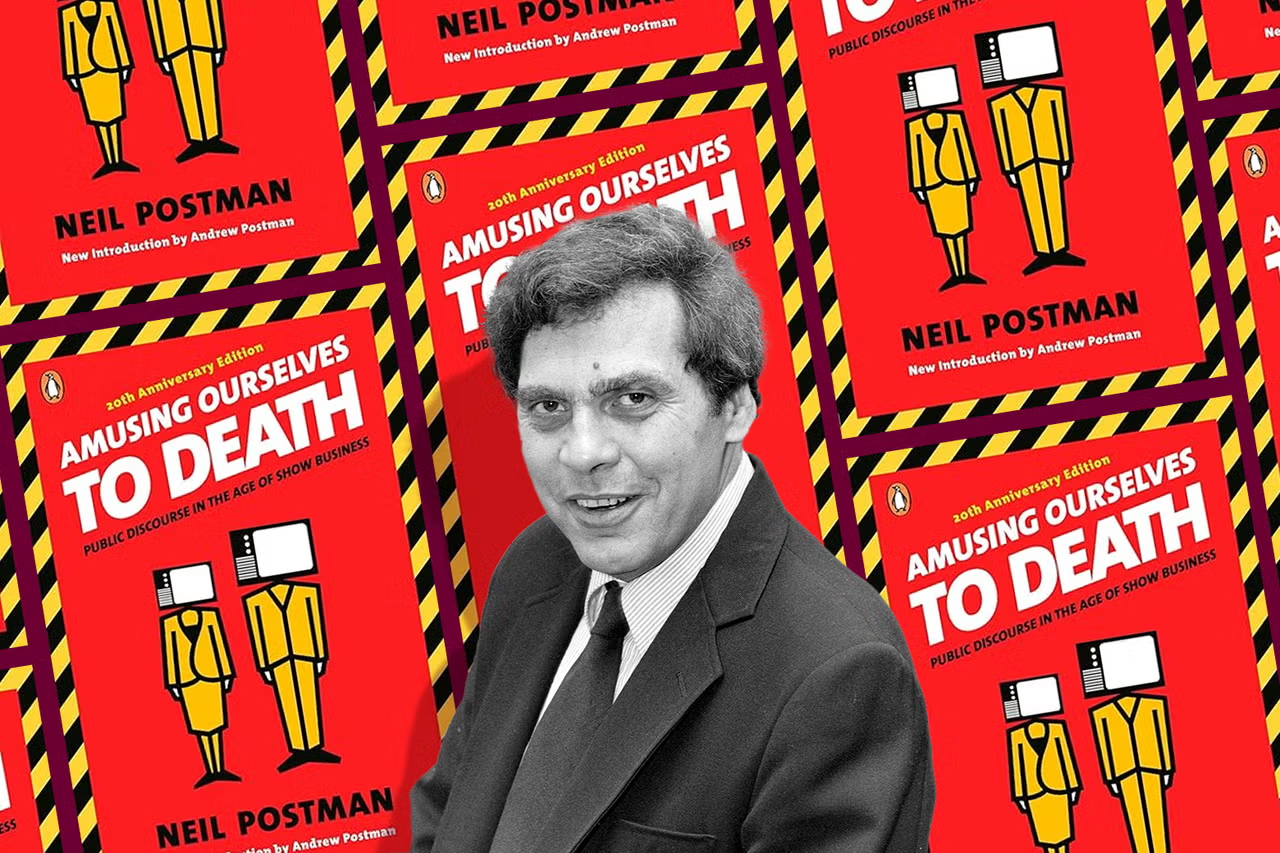
“Television, in other words, is transforming our culture into one vast area for show business. It is entirely possible, of course, that in the end we shall find that delightful, and decide we like it just fine. That is exactly what Aldous Huxley feared was coming fifty years ago.” – Amusing Ourselves to Death (foreword)
Neil Postman was an educator, but above all, he was a visionary who could understand and see through the mirage of television and its impacts to education, politics, and journalism.
Written in 1985 “Amusing Ourselves to Death” is a social criticism on public discourse in the age of what he calls “show business.”
What Postman is establishing is that we live in a reality where the television we consume has become one big play–a show, if you will, that is ever present–the television may have given us windows into peering through various worlds, but it goes without saying what we’ve lost because of its dominance.
In chapter four titled The Typographic Mind Postman connects the reader back to eighteen and nineteen century America. At the height of the printing press the printed word held attention and increased intellect. It also increased the normalcy for discourse on a level you don’t see in modern day United States. Public figures were known rather for their written works opposed to how they looked outwardly on television. It’s in these times in United States history where social discourse was taken as a serious matter rather than amusing play. In the age of the founding fathers, “mature citizenship was not conceivable without sophisticated literacy” to quote Postman.
Its not until we really reach the 1980s and beyond that we really begin to see a shift into how our culture is so attachment and disfigured due to television’s social influence.
Television has rendered our lives as incoherent as we have become bombarded with a high influx of information that we don’t know what to do with. Television has created a world in which what is presented is an elaborate show. Often hyper sensationalized to drive massive amounts of attention. Where we see conflict is with time; television news has been at odds the most with this conflict.
Postman suggests that the age of the written word is gone. In that time, politicians weren’t preoccupied with their image on television. The written word and its importance to American cultured allowed a space for high articulation and longer forms of discourse. The American populace understood the necessity of being strongly literate and forming cohesive arguments. As he discusses in the book the Lincoln and Douglass debates are a prime example of that as one candidate had a full one hour to speak and the other the same amount. Each of the seven debates was a three-hour affair.
As I mentioned, television is at odds with time. Because the medium’s strength is moving pictures “talking heads” has the increased likelihood of detracting viewers away. Television news’s rapid-fire presentations of stories render it incoherent because not a lot of quality time can be spent on one single story. To Postman, TV news is a peek-a-boo world–stories pop right into the audiences view just for it to go away in seconds. This is to the viewers determent as they never really have a fully grasp of a news story. The story is fully lost by the time the show momentarily closes so that advertisers can make their money and tap into the audiences’ desires and insecurities. Not to mention the way news is presented on television.
Anchors that never look out of place or overweight, into and outro music, and moments that encourage the viewer to stay. All these elements play a role in the news becoming a form of entertainment. When news becomes entertainment, it loses its seriousness and fails to truthfully inform. When news becomes entertainment, we lose the ability to think deeper and further question stories. We begin to have an expectation that news must be presented quickly. When news becomes entertainment topics become irrelevant and lose their severity. It’s hard to fully care about an earthquake in South America if the viewer will be met with an advert for McDonalds or American Egale shortly after. When news becomes entertainment political debates pay the price. Gone are the days of longer formed debates that had enough time to purposefully convey a politician’s full argument. Today, televised debates are once again a great show. The participants have far lesser time expressing their policy ideas and political stances. Because of this, politicians now tend to focus on how they look on camera and look to say witty things that can catch a sound bite. This only hurts the viewer who isn’t as informed as they were before they watched. Because of the mediums constraints with time and the politicians often focus on self-presentation over substance televised debates have become as enthralling as a action thriller on the silver screen. This though leaves viewers uninformed and less educated than they were before.
In a much specific sense, modern technology and its social media applications have played a part in us as a culture amusing ourselves to death. With the unfortune rise of shorted formed algorithmic content we are in a moment where many are hooked by what I call Red. 40 on video. Red. 40, the synthetic red food dye used in high processed foods and cosmetics gives the object vivid color and creates a taste that is sweet and addictive to its consumer.
Just like the food dye, to most consumers Red. 40 on video–on the surface is very sweet and the colors and the way in which it advertised entice the viewer to keep eating. (watching) Because of the ease of access and the taste of the content being sweet we’ve reached a point where we are hooked on what we’re eating without stopping to question what it’s made of. We continue to eat without really confronting how this content makes our stomachs (our minds) feel. That’s the scary thing about Red. 40 on video–about soma.
Television (and I’d argue modern technology, social media) is a form of soma. Soma is drug used by the inhabitants of the people in Aldous Huxley’s famous novel Brave New World--referenced many times by Postman in the book. The drug is an antidepressant used by the populace to escape reality, suppress emotion, and give the user calming, hallucinogenic effects. it’s also used to maintain the social order. What makes soma so dangerous is it makes us believe that what we’re taking feels right–feels true. It makes forget about what we don’t want to feel or see and transports us to a different place.
When televison becomes a form of entertainment, what we once deemed as important or sacred erodes. When television and social media become forms of soma its populace interacts with these things at an unconscious level. We fail to remember what was important in the first place, we lose the ability to properly communicate outside of our global village, we feel disconnected from reality so we push ourselves deeper into the digital world hoping we may find people we can connect with. When it becomes soma, it consumes us. When we amuse ourselves to death, we are all the more easily controlled and less informed. The time Tik Toks on by while we waste our time and bombard ourselves with information.


